

MIAS 2026: Who Owns Every Brand at the Show—A Complete Guide
22 of 25 brands at MIAS 2026 are Chinese-owned. Here's a breakdown of every corporate family, who owns who, and what it means before you buy.
GUIDESEV NEWSEV SPOTLIGHT
4/14/20264 min read
Behind the Badges: Understanding the Brand Families of MIAS 2026
MIAS 2026 brought 25 brands to the World Trade Center last April 9-12. But many of those badges shared the same corporate parent. Here's who owned who—and why it still matters if you're shopping for an EV.
Walking the floor of MIAS 2026 at the World Trade Center last April 9-12, you would have seen around 100+ vehicles representing represented by 25 brands. On the surface, it looked like an exciting celebration of automotive diversity. But look a little closer at the corporate logos behind the logos, and a single, undeniable pattern emerges—the Manila International Auto Show became, in large part, a showcase of Chinese automotive ambition.
That's not a criticism. It's a market reality worth understanding, especially if you're thinking about buying an EV.
22 Out of 25. Let That Sink In.
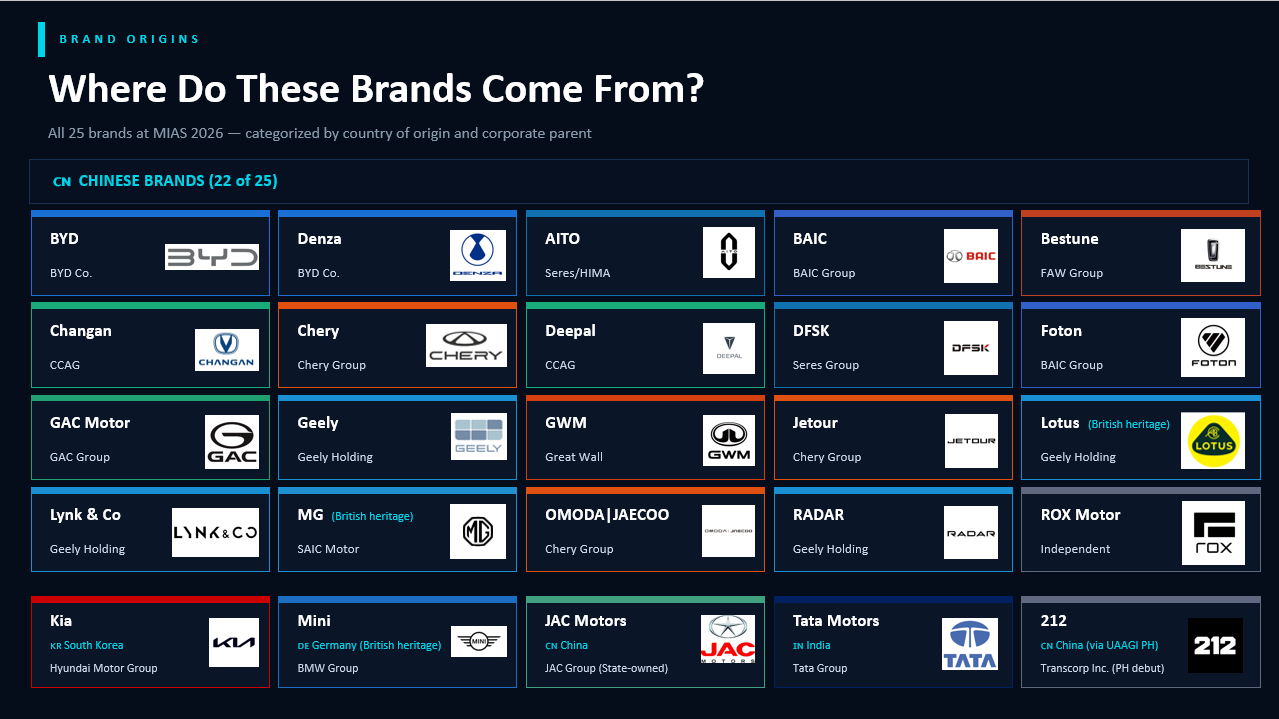
Of the 25 brands at MIAS 2026, 22 were Chinese in origin. Only KIA (South Korea), MINI (German-owned, British Heritage), and Tata Motors (India) represented non-Chinese OEMs. Everything else—from the mass-market staples like BYD and Geely, to the newcomers like Deepal, AITO, Bestune, ROX Motor, and 212—traced back to a Chinese conglomerate, state-owned enterprise, or startup.
This isn't a coincidence. It mirrors a global trend: China now accounts for roughly 55% of all pure electric vehicles (BEVs) sold worldwide. The Philippines, which has been actively incentivizing EV adoption through the EVIDA Law (RA 11697), has become a target market for Chinese OEMs looking to expand beyond their home turf.
The question isn't whether Chinese EVs belong here. They're already here, with aggressive pricing and a rapid model rollout strategy that traditional Japanese and Korean OEMs are still scrambling to match.
Behind the Badges: Who Owns Who?
This is where it gets interesting, and where many Filipino buyers were caught off guard.
The MIAS 2026 floor wasn't 25 independent companies competing head-to-head. It was more like 9 to 10 corporate families, each fielding multiple sub-brands positioned at different price points and market niches. Think of it the way Toyota fields Lexus for luxury buyers while keeping the Vios for the everyday commuter. Except here, the scale is much, much larger.
BYD is the easiest example. Most people know BYD Auto—the Atto 3, Sealion, Seagull, and Dolphin. But BYD Co. Ltd. also owns Denza, a luxury EV brand that made its Philippine debut at MIAS 2026 with the D9 MPV and the Z9 GT as some of its models. And then there's Yangwang (a performance-focused, sports car not yet here) and Fang Cheng Bao (also a performance-focused, off-road luxury "Leopard" brand, also not yet local). One corporate parent, four brands targeting completely different wallets.
On the other side of the road, we have Zheijiang Geely Holding, and was arguably more complex. At MIAS 2026, Geely Auto, Lynk & Co, Lotus, and RADAR all appeared, although Lynk & Co and RADAR are distributed by United Asia Automotive Group, Inc. (UAAGI PH) together with Chery, Foton, BAIC, and Jetour. Furthermore, Geely also owns Volvo and holds a stake in Polestar, though those weren't present at the show. And yes, Lotus, the British sports car brand, is now a Geely company. In addition, RADAR is Geely's EV pickup truck brand, which made its Philippine debut at the show with the RD6.
Furthermore, Chery Group showed up as four distinct brands: Chery itself, Jetour (adventure SUVs), Omoda (lifestyle-premium), and Jaecoo (rugged-premium).
Meanwhile, China Changan Auto Group (CCAG) brought both Changan (a mainstream ICE/HEV brand making its PH debut) and Deepal, an EV-first premium brand co-developed with Huawei and CATL, launching the S05 and S07 REEV models here.
What This Means for You as a Buyer
Understanding brand hierarchies isn't just trivia — it has real consequences for ownership.
Aftersales risk is brand-specific, not group-wide. Just because BYD Auto has a growing service network in the Philippines doesn't mean Denza will have the same support infrastructure from day one. When buying a sub-brand making its local debut, always ask: How many dedicated service centers does this brand have? Where are they? What's the parts availability timeline?
Battery warranties differ across the same parent group. Geely Auto and Lynk & Co may share a platform, but their warranty terms, service commitments, and local distributor agreements are independent. The same corporate parent does not mean the same ownership experience.
Brand exit risks for smaller players. Established conglomerates like BYD, Geely, and SAIC (which owns MG) have the financial depth to sustain long-term market presence. Startups like ROX Motor and 212 are a different calculation—compelling products, but with shorter track records and fewer safeguards if the market doesn't go their way.
None of this means you shouldn't buy from new brands. It means you should go in with eyes open.
The Bigger Picture
MIAS 2026 was an indicator of what's to come. For decades, the Philippine car market was Japanese dominated—Toyota, Honda, Mitsubishi, Nissan, Isuzu—brands with decades of local trust, dense service networks, and parts ecosystems that could survive a shortage without skipping a beat.
Chinese OEMs are not yet at that level of ecosystem maturity here. But they moved faster at MIAS 2026 than anyone expected, and the price points that make the math increasingly hard to ignore.
For Filipino buyers considering their first EV, the MIAS 2026 was both exciting and overwhelming. The brands were many, the names were new, and the ownership trees were tangled. But peel back the badges, understand who owns who, and the market starts to make sense.
The age of Chinese EVs in the Philippines is here.
For an in-depth discussion about these brands, check out our YouTube channel, @evexplorerph.

Your go-to hub for EV news, guides, and insights built for Filipino roads.
Navigate
© 2026 EV Explorer PH. evexplorerph.com. All rights reserved.


Legal